





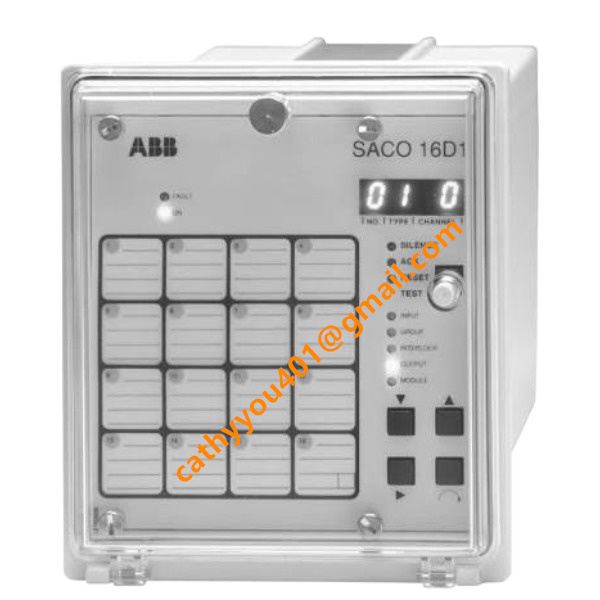







Description
-
BrandABB
-
ModelSACO 16D1
-
Product Name16‑Channel Digital Annunciator Unit
-
Dimensions160 mm × 100 mm × 145 mm
-
Weight0.92 kg
-
Place of OriginFinland
-
HS Code85312000
-
Operating Temperature‑10 ℃ to +55 ℃
-
Storage Temperature‑40 ℃ to +155℃
-
Power Supply48 V DC
-
Warranty12 month
-
Statusnew and original
ABB SACO 16D1 Technical Overview
Inputs
Equipped with 16-channel binary digital alarm inputs, compatible with field NO/NC dry contact signals. Built-in 48 V DC excitation voltage is provided for field contact detection.
Outputs
Features 4 sets of potential-free relay outputs, including 2 group alarm relays, 1 audible alarm relay and 1 self-supervision fault relay. Relay contact rating: 250 V AC, 3 A (resistive load). Integrated RS-485 SPA-bus serial communication interface for data transmission.
Power Supply & Operating Current
Dual power module options for wide-range power adaptation:
SPGU240A1: 80–265 V AC/DC
SPGU48B2: 18–80 V DC
Typical operating current: 120 mA @ 220 V DC
Internal field detection power supply: 48 V DC
Supported Configuration Software
Professional ABB SMS 010 PC software for remote parameter configuration; local parameter setting is also available through the front panel physical buttons of the device.
Compatible Systems
Fully adapted to ABB SPACOM protection series and substation automation systems. Supports docking with third-party SCADA and DCS systems via RS-485 SPA-bus communication. Capable of independent standalone alarm annunciator operation.

ABB SACO 16D1 Troubleshooting
Displayed Fault Codes
Fault code1: Missing parameter-memory circuit
Remedy: Check installation status of D17 parameter-memory chip; reinstall the memory module in correct orientation; replace the memory chip if it is damaged.
Fault code2: Parameter-memory checksum error
Remedy: Reload configuration through SMS 010 software; restore factory defaults and re-configure all channel parameters; replace the defective memory chip.
Fault code3: Blocked event register (contact bounce / frequent chattering)
Remedy: Check bounce phenomenon of field dry contacts; increase the input debounce delay parameter; eliminate on-site mechanical contact vibration; power-cycle the device to unlock the event register.
Fault code4: Undervoltage for internal 48 V DC field-contact power supply
Remedy: Confirm auxiliary input power supply stays within rated range; inspect the internal power module; replace SPGU power unit when output voltage is out of specification.
FAULT LED is ON and self-supervision relay is de-energized
Remedy: Read fault code from front-panel display; check auxiliary supply voltage and protective earth connection; look for internal hardware faults; reboot the device; contact ABB technical support if the fault remains.
Blinking decimal point on display: SPA-bus communication failure
Remedy: Verify RS-485 wiring polarity, cable integrity and terminal tightness; ensure consistent SPA-bus address and baud-rate at both communication ends; inspect bus termination resistor; remove bus short-circuit fault; restart upper SCADA/DCS system.
No power indication, all front-panel LEDs remain off
Remedy: Measure auxiliary supply voltage at power terminals; confirm the selected power module (SPGU240A1 / SPGU48B2) matches site voltage requirement; check fuse condition; replace faulty plug-in power module.
Alarm input channel does not respond to field contact status change
Remedy: Ensure configured contact type (NO / NC) conforms to actual field hardware; test internal 48 V DC excitation voltage; check continuity of input loop wiring; modify input-delay setting; verify on-site contact performance; replace damaged input circuit board.
Relay outputs cannot be triggered by alarm signals
Remedy: Check logic settings of group alarm and audible alarm; measure relay contacts with multimeter; inspect external load wiring; make sure no short-circuit exists on output terminals; replace main logic module in case of hardware damage.
Continuous random false alarms
Remedy: Raise input debounce time; reduce electromagnetic interference for field contacts and separate signal cables from high-voltage lines; confirm reliable protective-ground connection; check stability of internal 48 V excitation voltage.
Front-panel local buttons are unresponsive
Remedy: Trigger LED self-test by holding the acknowledge/reset button for more than 1 second; restart the unit; clear locked fault status; restore factory settings and download parameters again; replace main module upon confirmed hardware defect.
General Maintenance Tip
Apply ESD protection when handling plug-in modules. The D17 parameter-memory chip can be migrated to a new SWPA 3A1 main module to preserve original configuration without re-programming. Internal components shall not be disassembled without ABB-authorized qualification.

GDB021BE
Unitrol 1020
698B275U01
SM810K01
BC810K02
PP886
PBA800
RED615